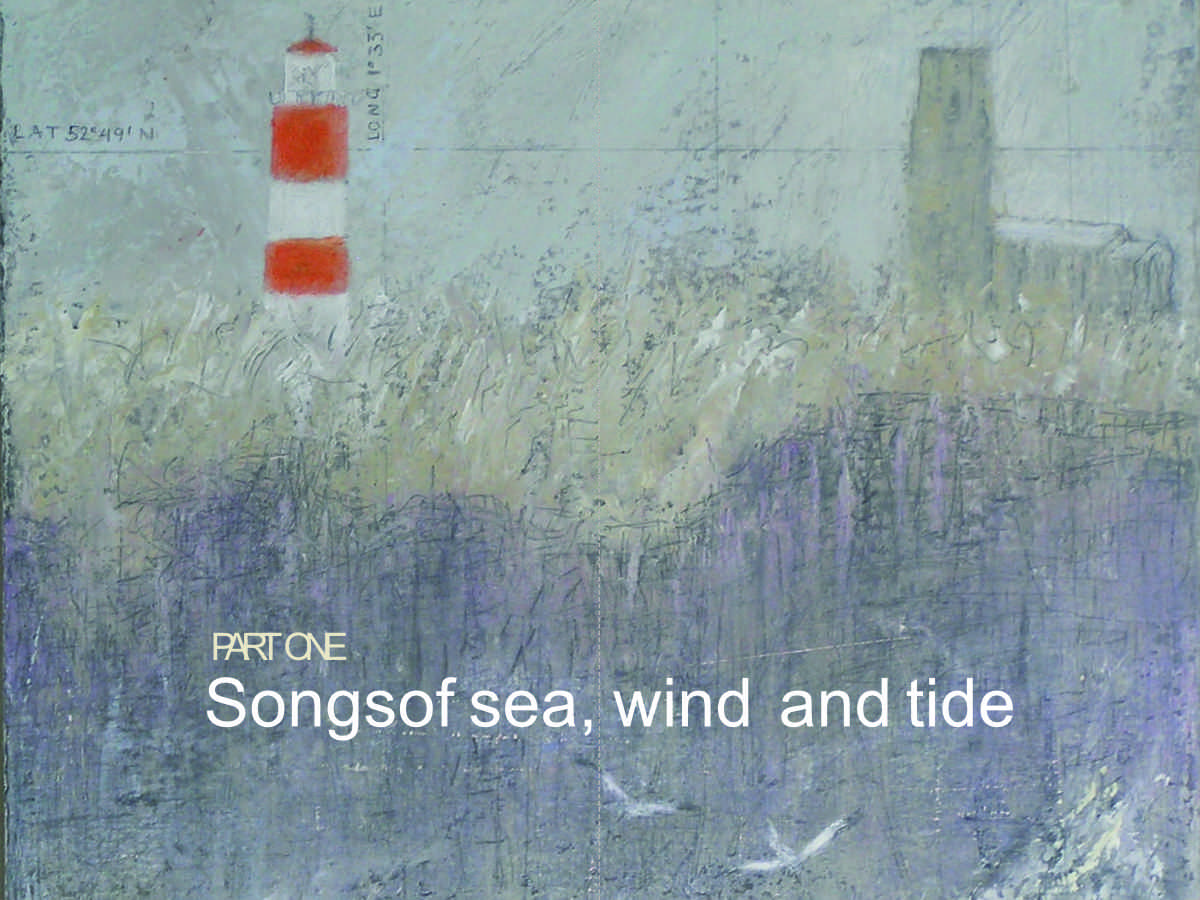


A poetic elegy to the eroding landscape of the east coast, the raw power of the sea and the wind, and the transient emotions of love and loss with the artwork of Caroline McAdam Clark.,
£14.99
11 available in stock
Tidal Surge is a series of meditations about the raw power of the sea and the wind, and the transient emotions of love and loss, through the interplay of poetry and art. It is an artistic collaboration between writer Peter Lavergne and painter Caroline McAdam Clark who have both made their homes on the East Anglian coast.
This beautifully crafted book is a record of many years of reflection and creativity, and an elegy to the eroding landscape of this wild shoreline, from a ruined medieval church on a clifftop to the abandoned military buildings on Orford Ness.
Created with high production values (including 52 original colour illustrations, good quality paper and a binding of French flaps), this makes a great gift for Christmas or birthdays, or a great souvenir to remember a holiday in East Anglia. A section at the back of the book includes information on featured historical sites in East Anglia, from Orford Ness and Aldeburgh in Suffolk, to Walsingham and Salthouse in Norfolk. The book was successfully launched at the Royal Watercolour Society in Trafalgar Square, as part of Caroline McAdam Clark’s exhibition Common Ground.
Words by Peter Lavergne
Peter is half-English and half-French. He lives on a houseboat on an estuary in East Anglia, half on land and half on water. Under another name he has written books and stories about love, purgatory and creativity. This is his first volume of poetry.
Art by Caroline McAdam Clark
Caroline’s father was Scottish and her mother was French. Chance led them to put down roots in Suffolk. Edinburgh University and College of Art led her to become a visual artist, with a particular debt to her first tutor Elisabeth Blackadder. Over the decades she has clocked up some twenty-five solo exhibitions in the UK and abroad. This is her first collaboration.
This book is named after a strange weather condition known as a tidal surge. If you don’t live near the coast then you’ve probably never heard of a tidal surge, and I certainly hadn’t. On the 5th of December 2013 I was on a houseboat on the Deben estuary and the news on the radio was talking about a major tidal surge that was on its way down the east coast, with severe flooding likely to result. It turned out to be one of the strangest experiences of my life and it made me write the first poem in this book.
I have since learnt that a tidal surge happens when high tide combines with a low-pressure cyclonic weather system out over the sea, resulting in an extra surge of water that moves slowly along the coast and up the river estuaries, channelled by the land and pulled by the moon. In those few hours, the confluence of those massive natural powers creates something even more immense. It is not a single huge wave, like a tsunami, or even lots of big waves (unless there is also a strong wind to whip the water up). It is more of a creeping, ghostly, silent thing.
After writing that first poem, I couldn’t stop thinking about the power of the currents and longshore drift, gales and cyclones, tides and turbulence. Everything in the sea is always moving and changing, so erosion in one place becomes sediment in another place along the coastline. Everything is symbiotically linked.
And then I remembered that we humans are mainly made up of water. Our hearts and brains are seventy-five per cent fluid and awash with hormones: the chemical messengers that ebb and flow throughout our lives, influencing our behaviour and emotions. And then we pour in new waves of stimulants like coffee, drugs and drink, to either excite ourselves or unwind again. We think our minds are sentient and rational, but in fact we are all floating on the depths. Love, depression, anxiety, adolescence, menopause… they are all part of our tidal surge.
So, this book is the direct result of that extraordinary night on the river and the many days of thinking that followed it. A whole decade has slipped past since the 2013 tidal surge, and this year is also the seventieth anniversary of the catastrophic tidal surge of 1953, which claimed the lives of 300 people here on the east coast of England, and more than 2,500 people in total. So, we must never underestimate the brooding power of the sea.
I now live on a houseboat on the Deben, and I go up and down with the tide, twice a day, and it always reminds me that the tidal surge can and will happen again, perhaps when I am least expecting it. It is beyond my control.
Peter Lavergne,
Woodbridge, Suffolk.
Autumn 2023.
The pull of the sea is very strong for me. Or is it just the pull of water? From childhood my life has been punctuated by prolonged periods in Aldeburgh, always within sight of the North Sea or sailing my dinghy on the river Alde.
I have taken inspiration from many places over the decades, but the drawings and paintings in this book relate to my ongoing love affair with this corner of Suffolk. It has shielded me and given me solace, as well as providing an endless source of inspiration, not least the twelve or so disintegrating wooden fishing boats that lie scattered about the shingle beach, sad reminders of a vanished
fishing community.
Today it is the windfarms that populate the horizon, the cranes that work the port of Felixstowe, and further south the string of martellos that stetch into Kent which can excite my imagination. All this, and so much more provides me with rich pickings whether as starting points for observational drawings or as food for the imagination later to be transformed into paintings with a life of their own. And if I pay attention, even sounds can sometimes be seized and fixed on paper or canvas. Sounds like the wind rustling through the reed beds, a curlew’s eerie cry, the high pitched shrieks of the swifts, and if I am lucky the boom of the bittern in April.
So when I encountered Peter’s poems, about the sea, my sea, my river, my marshlands, drowned medieval churches, pebbled beaches and associated ‘business’ of the coast, I sensed a kindred spirit with a similar sensitivity to mine for this part of the world.
When he suggested a form of collaboration that did not rely on my illustrating his poetry or he making poems drawn from my imagery, I was delighted to embark on this creative project with him and perhaps between us create a resonance for other lovers of this wild area of the North Sea.
Caroline McAdam Clark,
Aldeburgh, Suffolk.
Autumn 2023.



This website uses cookies to ensure you get the best experience on our website. Find out more.